
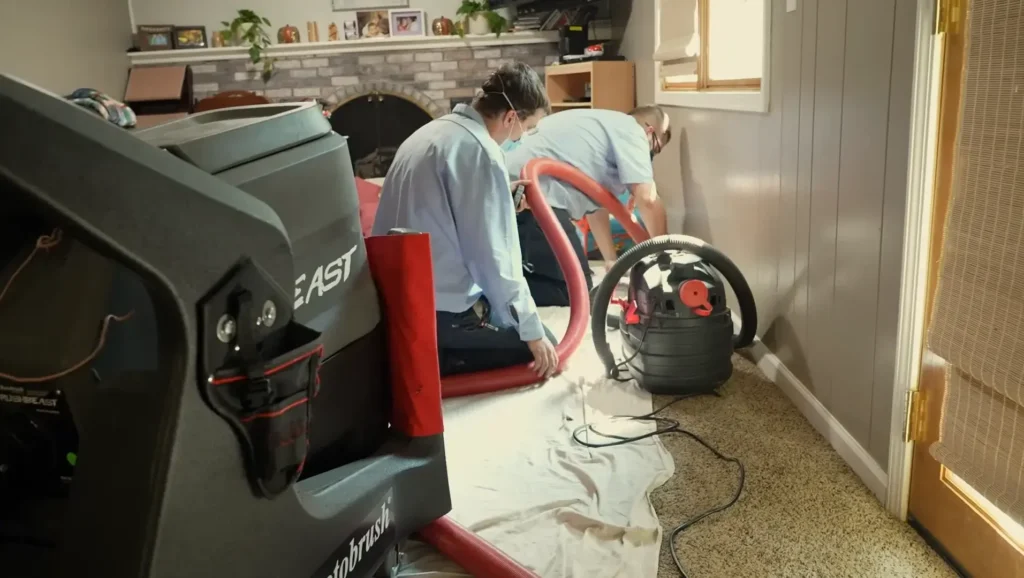
Emergency Dryer Vent Lint Removal in Carmel, IN: Rapid Hazard Mitigation and Airflow Restoration
Emergency dryer vent lint removal in Carmel, IN provides immediate, high-volume extraction of impacted flammable debris from obstructed exhaust lines to eliminate severe fire hazards, prevent thermal shutdown, and restore safe appliance venting. Our emergency protocols resolve dangerous overheating, burning smells, and backdraft airflow within hours across Hamilton County homes and commercial properties.
Residential architectural trends across Carmel frequently position laundry rooms in central interior spaces, second-floor hallways, or basements. These layouts require long, concealed vent runs navigating multiple 90-degree elbows through floor joists and wall cavities before reaching exterior termination hoods. When lint bypasses the interior lint screen, high humidity causes these fine organic fibers to stick to smooth duct interiors, creating dense air dams.
Operating a modern dryer against a choked exhaust pipe causes internal cabinet temperatures to spike rapidly. This severe backpressure forces scalding air back into the drum, tripping high-limit thermal fuses and charring trapped debris inside the heating element chamber. We provide specialized rapid-response intervention to clear these life-safety hazards before catastrophic thermal events occur.
Critical Red Flags Requiring Immediate Vent Clearing
Immediate emergency intervention is required when clothes dryers produce burning odors, excessive exterior cabinet heat, mid-cycle safety shutoffs, or moisture accumulation on laundry room walls. Operating an appliance under severe backpressure forces heat backward into the blower wheel housing, increasing thermal buildup and dramatically heightening ignition risks within hidden residential duct runs.
During emergency field calls in Carmel, we routinely observe system warning signs that property owners initially overlook. A single load taking longer than 45 minutes to dry is never a minor inconvenience; it indicates that linear airflow velocity has dropped below the threshold needed to carry moisture and lint outside. When the exterior damper flap remains closed or only flutters weakly during operation, lint has already compacted into a solid plug.
According to published statistical safety evaluations from the U.S. Fire Administration (USFA), fire departments respond to an estimated 2,900 home clothes dryer fires each year, with failure to clean lint from exhaust lines standing as the leading factor contributing to 34 percent of ignition events. When thermal sensors fail under continuous heat exposure, accumulated lint in the cabinet or ductwork serves as the primary fuel source.
- Burning Scorched Odor: Discontinue appliance operation immediately if you detect hot metallic or smoky smells.
- Excessive Cabinet Temperature: Touch the top and sides of the dryer unit; scorching exterior surfaces signal severe backpressure.
- Moisture Condensation: Look for water droplets running down walls or collecting around the flexible transition hose.
- Mid-Cycle Appliance Shutdown: Automatic shutoffs occur when the high-limit safety thermostat trips due to trapped heat.
Complex Field Diagnostics: Solving Real-World Carmel Obstructions
Complex dryer vent blockages often stem from localized structural challenges, including extended concealed duct runs, crushed flexible transitions, and secondary bird nest impactions at elevated wall or roof termination caps. Our specialized field team utilizes rotary pneumatic whips, high-static negative pressure HEPA extractors, and thermal imaging cameras to safely dislodge dense obstructions without damaging rigid aluminum conduits.
In a recent emergency dispatch to a two-story estate in the Village of WestClay in Carmel, IN, we addressed an ongoing dryer thermal trip issue. The home featured a 38-foot concealed exhaust line running through an insulated floor space with four 90-degree turns. Previous standard brush attempts had pushed a massive lint mass around the third elbow, completely sealing the 4-inch rigid duct and trapping gallons of condensed water behind the blockage.
To safely rectify this complex structural obstacle without breaching drywall, our team performed a structured sequential recovery procedure:
- Executed baseline static backpressure and velocity readings at the interior connection point using a digital anemometer and differential pressure manometer.
- Connected a continuous high-volume negative-pressure HEPA extraction system to the dryer transition duct to maintain full containment inside the living space.
- Deployed a non-abrasive reverse-flushing pneumatic air whip down the 38-foot conduit to break up the wet, compacted lint plug from the inside out.
- Extracted over eight pounds of saturated lint debris and verified 100 percent wall-to-wall clearance using a 50-foot fiber-optic inspection camera.
We encountered another demanding emergency at a commercial pet grooming facility in downtown Carmel. Heavy daily towel drying had driven wet fur and lint deep into an underground 4-inch PVC slab conduit. We applied specialized bio-enzymatic softening agents alongside pneumatic rotary scrubbing devices to emulsify the hardened organic barrier, fully restoring high-velocity exhaust air volume without compromising the slab structure.
Comparing Emergency Vent Restoration Methods and Trade-Offs
Selecting the proper dryer vent restoration method depends directly on duct material, total run length, and blockage density. While basic mechanical brushes risk disconnecting hidden joints inside wall cavities, professional high-pressure pneumatic air whipping paired with high-volume HEPA extraction cleans complex runs completely while preserving structural duct integrity and indoor air quality.
Data published by the National Fire Protection Association (NFPA) indicates that dust, fiber, and lint are the first materials ignited in 27 percent of home dryer fires. Utilizing improper cleaning tools on long, winding duct runs can exacerbate this risk by compacting debris into tight internal elbows or detaching underlying duct segments behind drywall.
| Method | Execution Technique | Suitable Vent Types | Risk Profile | Efficiency Rating |
|---|---|---|---|---|
| DIY Flexible Rod Brushes | Hand-pushed plastic rods with nylon brush heads | Short straight runs under 10 feet | High risk of rod breakage and pipe disconnection inside walls | Low (20% to 40% debris removal) |
| Motorized Rotary Scrubbing | Electric drill-powered flexible shaft brushes | Rigid sheet metal runs up to 20 feet | Moderate risk of tearing thin foil or semi-rigid flex hoses | Moderate (60% to 75% debris removal) |
| Reverse Pneumatic Air Whip & HEPA Extraction | High-pressure multi-directional air nozzles with negative pressure vacuum | All run lengths, multi-story, and concealed building ducts | Zero structural risk, zero dust displacement into home | Maximum (95% to 100% debris removal) |
Mechanical brush rods often struggle in Carmel homes that feature rigid ductwork connected with internal sheet metal screws or offset elbows. In contrast, pneumatic air whips deliver up to 100 pounds per square inch of compressed air that dislodges hardened lint without snagging on internal seams. Pairing air whipping with HEPA negative air containment guarantees that loose lint and dust spores do not escape into your home’s breathing air.
Decision Framework for Homeowners and Property Managers
A sound maintenance and emergency response decision depends on venting geometry, usage frequency, and warning severity. If your line exceeds 15 feet, contains multiple directional turns, or exhibits thermal shutdown, immediate high-pressure professional remediation is required over standard routine brushing to prevent structural fire hazards and premature motor burnout.
When evaluating your laundry setup in Carmel, apply conditional logic based on physical inspection markers and operational symptoms:
- If your clothes dryer cabinet becomes uncomfortably hot to the touch during a cycle, immediately halt operation and disconnect the power supply to prevent heating element burnout.
- If your vent pipe exits through an elevated roof cap or second-story gable, do not attempt ladder-based clearings during icy Indiana winter weather; utilize professional ground-to-roof pneumatic purging.
- If you observe flexible vinyl or slinky foil ducting connected to your machine, replace it immediately with rigid galvanized steel or UL 2158A compliant semi-rigid metal tubing to meet local safety codes.
- If your laundry facilities service multi-family properties or commercial operations, establish semi-annual scheduled pneumatic purges to handle continuous heavy volume demands.
Frequently Asked Questions
Frequently Asked Questions
How quickly can emergency dryer vent lint removal be performed in Carmel, IN?
Emergency dryer vent lint removal services in Carmel, IN are typically dispatched within one to two hours to mitigate immediate fire hazards and thermal risks. Our local service teams arrive fully equipped with high-pressure pneumatic clearing units and video inspection equipment. We prioritize active burning odors, system overheating shutoffs, and severe laundry moisture backups across Hamilton County.
What causes a dryer vent to clog so severely that it requires emergency clearing?
Severe dryer vent blockages occur when wet lint accumulates along long duct runs, sharp elbows, or restrictive exterior vent hoods until exhaust airflow drops below critical velocity. In Carmel homes, extended concealed runs through floor joists and uninsulated attic spaces exacerbate moisture condensation, causing lint to adhere firmly to duct walls. Animal nesting materials, crushed flex lines, and heavy laundry loads accelerate this clogging process dramatically.
Is a burning smell from the dryer always caused by lint buildup in the vent?
Yes, a burning smell is most frequently caused by trapped lint contacting the dryer heating element or electrical components due to restricted exhaust airflow. When lint cannot exit through the vent line, backpressure forces dry fibers into the cabinet housing where temperatures reach ignition levels. However, burning odors can also indicate a failing drive belt or motor bearing, requiring immediate shutdown and professional diagnostic evaluation.
How much does emergency dryer vent lint removal cost in Carmel, IN?
Emergency dryer vent lint removal in Carmel, IN generally ranges from 175 US Dollars to 350 US Dollars depending on duct length, blockage severity, and accessibility. Complex multi-story ceiling runs or roof-terminated vents requiring specialized rigging may incur higher rates due to labor intensity. We provide upfront flat-rate estimates before commencing work so property owners experience complete pricing transparency.
Can I clear an emergency dryer vent obstruction myself using a store-bought kit?
You should not attempt DIY emergency clearing on long or concealed dryer vent lines because flexible rod kits frequently snap or disconnect inside hidden wall cavities. Store-bought rods lack the power to dislodge heavily compacted wet lint plugs and can puncture flexible or semi-rigid metal piping. Professional emergency service employs reverse pneumatic whips and HEPA extraction systems that guarantee complete wall-to-wall removal without damaging duct infrastructure.
Sources
- U.S. Fire Administration (USFA): https://www.usfa.fema.gov
- National Fire Protection Association (NFPA): https://www.nfpa.org