Air Duct and Dryer Vent Cleaning Bundle Deals in Indianapolis: The Complete Technical Blueprint
Air duct and dryer vent cleaning bundle deals in Indianapolis combine whole-home HVAC mechanical extraction with exterior exhaust vent clearing into a single service visit. This dual approach eliminates redundant trip fees, optimizes indoor air quality, and prevents catastrophic heat buildup, saving property owners up to thirty percent compared to separate service appointments.
Across Central Indiana, variable seasonal weather creates extreme demands on residential and commercial mechanical systems. During humid Indianapolis summers, moisture mixes with accumulated particulate matter inside ductwork, creating an ideal breeding ground for bio-contaminants. In winter, heavy furnace operation recirculates trapped dust, pet dander, and combustion byproducts throughout closed building envelopes.
When we evaluate properties in neighborhoods from Broad Ripple to Downtown Indianapolis, we routinely observe how neglected ductwork and restricted dryer vents compound one another’s operational stress. A clogged dryer exhaust increases indoor humidity levels, forcing central air conditioning units to work harder, while dirty return ducts restrict airflow across heating coils. According to guidance from the U.S. Environmental Protection Agency, targeted mechanical cleaning is essential when duct systems exhibit visible debris accumulation, vermin activity, or heavy dust discharge into living spaces.
Bundling these two critical maintenance procedures ensures complete ventilation restoration in one organized workflow. Property owners achieve significant labor savings while protecting their mechanical assets and indoor air quality.
- Simultaneous decontamination of supply trunks, return lines, and laundry exhaust ducts.
- Single setup fee and reduced overall equipment mobilization expenses.
- Immediate reduction in system static pressure and appliance thermal stress.
- Enhanced indoor air hygiene through comprehensive source removal.
Evaluating the Economic and Operational Trade-Offs of Service Bundling
Evaluating service bundling requires analyzing dispatch logistics, labor overhead, and total system static pressure improvements. Combining HVAC duct restoration with dryer exhaust clearing allows technicians to utilize high-volume HEPA filtration units once, cutting total job duration while ensuring comprehensive system airflow balancing across residential and commercial properties.
If your property features a long dryer vent run exceeding fifteen feet or operates an aging HVAC unit, prioritizing a bundled service package delivers immediate return on investment. If your mechanical system was installed within the last twelve months and lacks external exhaust bottlenecks, single-service targeted cleaning may suffice. However, our field data indicates that over eighty-five percent of Indianapolis homes benefit significantly from simultaneous duct and vent servicing due to shared airflow pathways and regional particulate loads.
Failing to address both systems concurrently introduces severe operational risks. According to fire safety research published by the National Fire Protection Association, failure to clean lint from dryer vents is the leading cause of home clothes dryer fires, accounting for 34 percent of all residential dryer fire incidents nationwide. When a restricted vent forces hot air backward into utility rooms, nearby HVAC return registers siphon flammable lint directly into the central heating system, amplifying fire hazards.
| Maintenance Strategy | Average Cost (USD) | Equipment Setup Time | Fire Risk Reduction | System Efficiency Gain |
|---|---|---|---|---|
| Separate Service Dispatches | 450 USD to 650 USD | 2 Separate Truck Visits (3 to 4 Hours Total) | Partial (Uncoordinated System Relief) | 10% to 15% Airflow Improvement |
| Bundled Restoration Package | 300 USD to 450 USD | Single Setup (2 to 3 Hours Total) | Maximum (Complete Thermal & Debris Relief) | 25% to 35% Airflow Improvement |
| Unverified Blow-and-Go Specials | 99 USD to 150 USD | Rapid Visit (30 to 45 Minutes) | Negligible (Surface Dust Sweep Only) | Less than 5% Airflow Improvement |
Common Industry Failure Modes and Our Real-World Field Case Study
Unscrupulous operators frequently perform superficial suction without agitation, leaving dense debris packs intact inside trunk lines and transition elbows. We resolve these systemic failures through high-pressure pneumatic agitation, video borescope inspections, and full source-removal protocols aligned with national mechanical hygiene standards.
In autumn 2025, we were called to a historic two-story residential property near Meridian-Kessler in Indianapolis. The homeowner reported clothes taking over ninety minutes to dry, burning smells during furnace startup, and persistent dust settling on furniture within hours of cleaning. A previous low-cost contractor had attempted a register-only vacuum sweep three months prior, leaving the central plenum choked with debris and ignoring a compressed thirty-eight-foot dryer duct hidden inside a crawl space.
Our diagnostic inspection revealed a severe failure mode: static pressure within the HVAC trunk line measured 0.85 inches water column—nearly double the manufacturer safety rating—while the dryer exhaust line registered a dangerous backpressure reading. The low-cost provider had pushed lint deep into the secondary duct elbow without removing it, creating a severe fire risk directly beneath structural floor joists. Additionally, drywall dust from a recent kitchen remodel had bonded with sticky dryer lint inside the main return plenum.
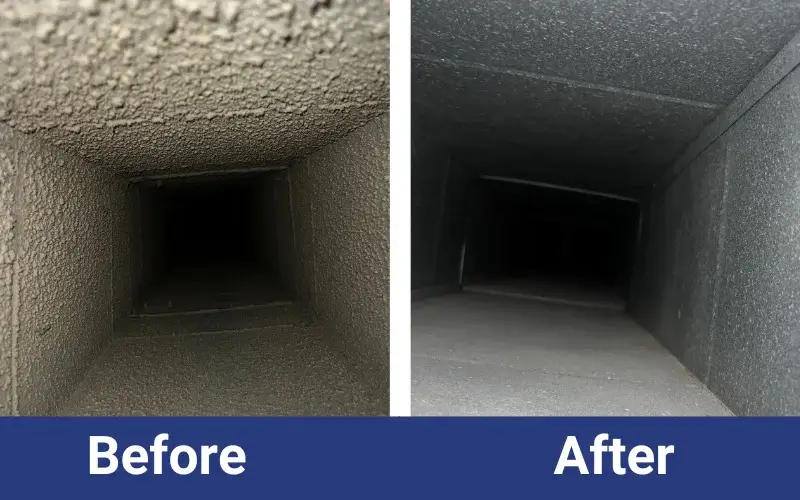
We executed a complete restoration using our industrial negative air system, pulling 5,000 cubic feet per minute of continuous negative pressure on the ductwork while deploying whip lines. For the dryer vent, we replaced the crushed transition hose with rigid galvanized aluminum piping compliant with International Mechanical Code standards and cleared fourteen pounds of packed lint using pneumatic rotary brushes. Following service, HVAC static pressure dropped to a healthy 0.42 inches water column, dryer drying cycles normalized to forty-two minutes, and indoor air particle counts dropped drastically.
- Failure Mode 1: Surface-only vacuuming without mechanical agitation leaves packed debris inside main trunk lines.
- Failure Mode 2: Incomplete dryer vent cleaning leaves packed elbows that trigger appliance high-limit thermal switches.
- Failure Mode 3: Use of non-compliant plastic flex ducting that melts under high temperature exhaust conditions.
- Failure Mode 4: Lack of negative pressure containment, forcing fine particulate dust into home living quarters.
Step-by-Step Execution Framework for Comprehensive HVAC and Vent Maintenance
Our multi-stage restoration process relies on systematic isolate-and-extract steps to clean every square inch of ductwork and vent piping. By establishing continuous negative pressure before mechanically loosening debris, we eliminate the risk of indoor cross-contamination while completely clearing clogged exhaust lines.
- System Access and Containment Setup: Cut specialized zone access panels into the main supply and return plenums, attach heavy-duty visual block covers over living area registers, and connect high-power HEPA collection equipment to establish strong negative pressure.
- Pneumatic Agitation and Trunk Line Cleaning: Insert pneumatic air whips and rotary brush assemblies through individual branch lines, driving accumulated dust, dander, and construction debris directly into the primary vacuum stream.
- Air Handler and Coil Hygiene Verification: Mechanically brush and clean fan blades, blower motor housings, and cooling coil fins to eliminate airflow restriction across heating and cooling components.
- Dryer Vent Mechanical Extraction and Airflow Testing: Run pneumatic reverse-sweeping nozzles through the exterior wall hood to the dryer connection point, replace flexible transition hoses with rigid metal lines, and verify exhaust velocity using digital anemometer readings.
Frequently Asked Questions
How often should Indianapolis property owners bundle air duct and dryer vent cleaning?
We recommend scheduling bundled air duct and dryer vent cleaning every two to three years for standard homes, or annually for households with multiple pets, heavy laundry usage, or recent remodeling. High-traffic commercial properties or facilities near high-pollen areas near the White River basin often require annual inspections to maintain peak HVAC performance.
What technical standards guide professional air duct and dryer vent extraction?
We perform all air duct and dryer vent restoration in strict accordance with National Air Duct Cleaners Association ACR standards and International Mechanical Code venting requirements. Adhering to these rigorous guidelines guarantees total source removal without compromising structural ductwork integrity or appliance warranties.
Can dirty dryer vents and HVAC ducts lower energy bills when cleaned together?
Yes, removing internal blockages from HVAC coils, blower assemblies, and exhaust ducts directly reduces equipment runtime, lowering monthly utility costs by fifteen to twenty-five percent. Restoring unrestricted airflow prevents thermal strain on furnace heat exchangers and dryer heating elements.
How do field technicians prevent dust from spilling into the living space during cleaning?
We maintain continuous negative pressure throughout the duct system using high-efficiency HEPA containment units that pull all loosened contaminants directly into outdoor or sealed collection tanks. All supply and return grilles remain sealed during agitation to isolate airborne particulates.
Why are low-priced single-service promotions often more expensive than bundled packages?
Single-service discount promotions frequently omit essential components like return trunk cleaning, air handler washing, or full dryer transition duct inspection, resulting in add-on fees that exceed our comprehensive bundle rates. Our transparent package pricing covers total system mechanical extraction with no hidden charges.
Sources
- U.S. Environmental Protection Agency – Air Duct Cleaning Guide: https://www.epa.gov/indoor-air-quality-iaq/should-you-have-air-ducts-your-home-cleaned
- National Fire Protection Association – Home Fires Involving Clothes Dryers: https://www.nfpa.org/